Oliver Rose
The War of the RosesOliver Rose’s struggle to keep his home after Barbara Rose tells him she no longer cares for him turns a marriage once organized around shared projects into a campaign of legal resistance and domestic retaliation. He insists that the house is his whole world; as the spouses convert that claim into action, the home that once embodied their joint ambitions becomes the setting of their fatal conflict.
Identity and Background
At a rainy auction in a sparsely occupied old house, Oliver sits several rows from the podium, his long legs stretched across the battered floor. The possessions of the Barker family lie behind the auctioneer, who struggles to persuade the audience that an abused rocking chair is an antique. Oliver is present before the decisive collapse of his own household, among strangers gathered to assign value to another family’s discarded things. The scene places him in a world where domestic objects can outlast the people who owned them, a contrast that grows sharper as his own marriage becomes a fight over possessions.
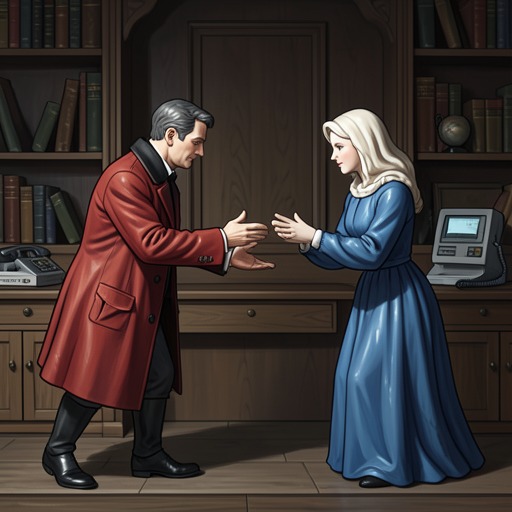
Barbara’s recollection of their life together supplies much of Oliver’s background. She had supported him through law school and performed the role of the traditional spouse while he advanced as a public servant, including making herself agreeable to his senior law partners. Their life accumulated through projects: raising children, tending plants, collecting antiques, moving from a small apartment to a suburban split-level, and finally pouring their energy and imagination into the large house. Oliver’s later insistence that the house belongs to him therefore grows out of a history in which work, ambition, family, and shared property were tightly interwoven.
He remains professionally occupied during the marriage’s breakdown. At a conference table in the chairman’s office in Manhattan, he takes notes on a company briefing about a special problem with the Federal Trade Commission. He has drunk more coffee than usual before lunch when pain strikes. As he sweats and the chairman’s words become muffled, Oliver tries to conceal his distress; he cannot swallow the water offered to him and is led to a couch. The episode exposes his vulnerability in a setting where he expects to function competently, and it precedes Barbara’s revelation that she had not cared enough to visit him in the hospital.
The Separation and the House
Barbara’s admission is not a sudden decision in her mind. She has been contemplating life without Oliver for a long time, though she cannot identify a single point when the marriage changed. Their life had moved from one joint undertaking to another; once the great house project was finished, she was left asking what would come next. When she tells him that she did not care whether he lived or died, Oliver struggles to accept that a relationship, a family, and a life together could be dismissed so abruptly.
Rather than leave, Oliver makes the house the central stake of the separation. Murray Goldstein explains that Title 16-904, Section C permits a no-fault divorce even when a couple lives under one roof, provided they live separately and do not cohabit; the waiting period is unaffected. But the rule does not settle who receives the house or its contents. A judge could order them sold and divide the proceeds, and an appeal could prolong the dispute. Oliver seizes on the possibility of staying, hoping his presence will demonstrate his commitment and perhaps force Barbara to go. Goldstein cautions him to consider the children, but Oliver imagines that Barbara can obtain another home with the money he is prepared to give her.
His attachment is more than a calculation about real estate. When Ann asks why he will not simply sell the house and split its value, Oliver answers that it is his whole world and asks why he should let Barbara take that world with her. He says he is willing to give her half its value, but invokes his payment, intelligence, and labor as reasons to claim it. Ann points out that it is also part of Barbara’s world and cannot continue to be shared in this way. Their exchange makes visible the mismatch between Oliver’s language of ownership and the history of a home built through both spouses’ lives.
Retaliation and Possessions
The orchids turn that dispute into a personal cycle of reprisal. After a Christmas Day that he remembers as happy, Oliver notices that the petals of Oliver’s orchids are browning and their stems bending. He recognizes in the soil the odor of the foam from a fire extinguisher and concludes that Barbara has damaged them. Because he had worked to grow the indoor cymbidiums, he interprets their destruction not as damage to a possession but as an attack demanding punishment.
He searches Barbara’s kitchen for a response and finds seven silver-wrapped meat loaves intended for her catering order. He seasons them heavily, using ginger, curry powder, salt, and, in one batch, sugar, then reshapes them in their wrappers. His plan is for Barbara’s customers to argue over what has spoiled the taste. The sabotage extends the spouses’ contest beyond the house: Oliver turns his knowledge of her work and its food into a means of retaliation, making the ordinary contents of a refrigerator instruments in their private war.
Oliver also discovers that their home is being watched. In Ann’s presence, he spots something above the bed canopy, moves a chair to inspect it, and follows a wire from Eve’s room along the corridor toward a window overlooking the garden. He retrieves a large knife and goes outside. He later sends Ann upstairs, dismantles the television equipment, removes the wire, smashes the camera with a sledgehammer, and crushes its pieces in the kitchen compactor before carrying the refuse to the alley. The discovery intensifies his sense that vigilance is necessary; the destruction of the equipment is both a practical response and another forceful assertion of control over the house.
The Ferrari offers a contrasting image of escape. After his sustained rage over the surveillance equipment begins to subside, Oliver uncovers his three-year-old car, removes its fiberglass top, and starts its eight-cylinder engine. He knows its value is appreciating and thinks of it as a carefully tended personal possession, one that gives him pleasure. For a moment he imagines driving away alone toward a new life, but the fantasy does not become a departure. He gets into the car and savors the leather and the engine’s power while remaining within the orbit of the struggle he has chosen to continue.
Conflict and Ending
Oliver understands Barbara’s actions through the injuries he believes she has inflicted on him. After an incident that leaves him weak and with painful lungs, he tells Goldstein that Barbara tried to kill him. He acknowledges that she is clever and mechanically capable, and says he had taught her much about mechanical things. Yet he does not tell Goldstein that he made a mold of the lock to Barbara’s room, fashioned a key, or substituted Dexedrine for the Valium in her capsules. He privately justifies keeping these acts secret by recalling what she has done to him, including the sauna and the wine. His account of the conflict is thus also self-protective: he presents his vigilance as necessary while concealing his own provocations.
After another painful morning, an ankle injury leaves Oliver leaning against a wall. Looking at his worn face in the bathroom mirror, he experiences what he calls a sense of liberation: doubt has disappeared, the sides are clearly drawn, and he understands the conflict as war. His anger is no longer hot, but controlled. He calls Miss Harlow to say that he will be away for a few days, then hangs up after indicating that he knows what he needs. The moment marks a change in how he inhabits the struggle: he no longer hopes that uncertainty will resolve it, but treats the contest as a settled condition requiring action.
At the final dining-room confrontation, Oliver insists that the house is his because he paid for it and says he will find a way to get it even if the courts decide otherwise. Barbara answers that this would be over her dead body; Oliver replies that he hopes so, if he can get away with it. She touches the blade of her cleaver, while he dismisses her objections as an attempt to escape an institution she hates. Their exchange brings the legal claim, the language of family, and the threat of physical violence into the same room. Oliver and Barbara ultimately die when their house collapses. The home he had defended as his entire world becomes the force that ends both their lives: his determination to keep it cannot preserve either the marriage or the people who made it a home.